
Carbon reduction by taking care of peatlands: The Care-Peat Project


SUMMARY
Covering only 3% of the world’s land area, peatland store over ¼ of the planet’s soil carbon with healthy peatlands acting to sequester carbon. Thus, their condition is important to combat climate change. Nevertheless, peatlands are drained for forestry, agriculture, and peat extraction, resulting in them becoming carbon sources rather than sinks. Currently drained peatlands account for over 5% of Global Greenhouse Gas (GHG) emissions. Irish peatlands cover over 20% of the landscape however over 85% are degraded and in bad ecological condition.
Thus, the initial aim of the project was to demonstrate the carbon reduction power of peatland restoration. However, the timing of the project also allowed us to make significant advances toward peatland policy development and publicly available tools to assist the future management of intact peatlands and agricultural areas on former peatlands. These tools will allow any landowner to estimate the carbon emissions from drained organic soils and offer alternatives to manage the water table to reduce emissions.
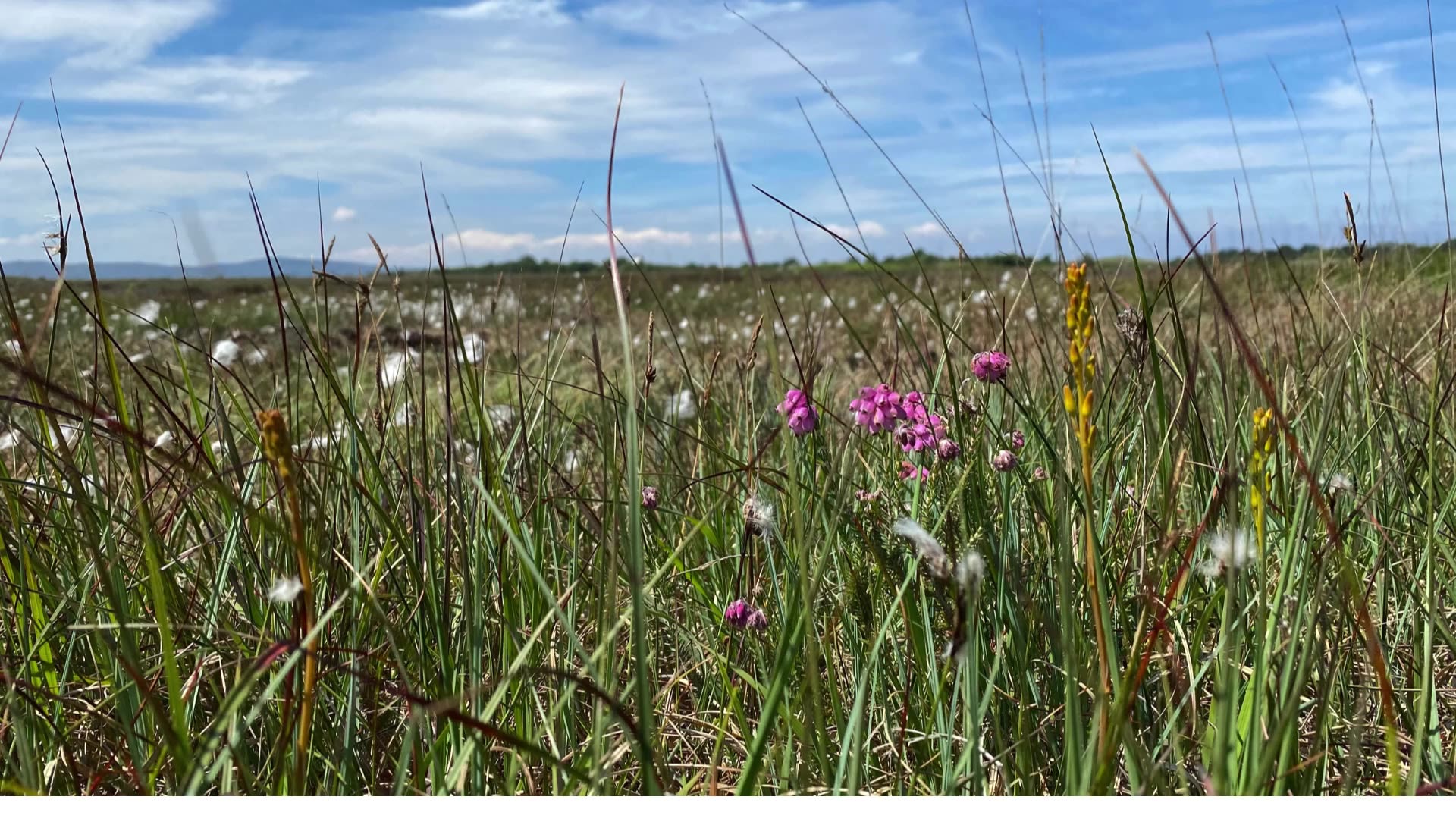

Meet the Care-Peat pilot sites: Cloncrow Bog, Ireland
Research Description
The project involved five countries (Ireland, France, Belgium, the Netherlands and the United Kingdom) working together to forge new understandings of peatland science, policy, and management. While the carbon benefits of peatland restoration are widely known in the scientific community, the project also aimed to inform the wider public and policymakers of the carbon benefits and possibilities for alternative management of degraded peatland areas.
Carbon Reduction and Carbon Tools
Our international joint restoration management team worked together to define best restoration practices. Unique to this project, we shared the same methodology and similar equipment to measure concurrent emissions. The collaboration resulted in enhanced carbon reduction and activities at each degraded peatland site (over 650 hectares) and progressed the state-of-the art in peatland restoration.
Using the common carbon data, we improved our understanding of the interaction between hydrology and emissions and simulated carbon fluxes via the development of a numerical model explicitly estimating current (and future) fluxes. Then, we integrated the data into a ‘Care-Peat Decision Support Tool’ (DST) to provide a user-friendly tool for site managers/owners to optimise the restoration and management of their sites.
Carbon Policy
Beginning in late 2020 we held policy workshops in each partner country that identified policy gaps and actions needed to move toward the adoption of alternative peatland management. These were held in each partner country and attended by over 400 people (20 in France, 40 in the United Kingdom, 24 in the Netherlands, 150 in Ireland, and 180 in Belgium).
These activities directly influenced International policy development (e.g., the Common Agriculture Policy and the Nature Restoration Law) toward the protection of peatlands and high-carbon soils.
Public Engagement and Knowledge Transfer
Our local & international workshops demonstrated a large disconnect between peatland greenhouse gas science and actionable measures by the public. We (CNRS, Manchester Metropolitan University, and the University of Galway) developed a decision support tool coupled with a financial feasibility tool that allows users (peatland managers or farmers) to estimate their emissions under different scenarios and the potential income from the carbon market after restoration. The University of Galway further developed these tools into an interactive web interface.
In 2023, Manchester Metropolitan University and the University of Galway conducted surveys of British and Irish farmer attitudes towards wetland farming (paludiculture). We found that the majority (~68%) of farmers had not heard of paludiculture, but were interested in learning more about it. Most farmers are concerned about land degradation and want to increase biodiversity to ‘do the right thing’ but are often most limited to market uncertainties. Our results indicated a lack of existing business case studies and an unwillingness to enter uncertain markets were the main barriers preventing uptake of paludiculture.

Details of the Impact
Carbon Reduction
The mean of total annual carbon saved by all approaches and partners is ~9,662 tCO2/year with reductions increasing as restoration progresses. We restored 855 hectares of degraded peatland and saved an average of 11 tCO2 per hectare with the largest savings in Belgium (250 ha) highlighting the need for large-scale restoration of peatlands.
We facilitated greater knowledge exchange through the development of long-term scientific working groups. These include the Peatland Research Support Group, Peatlands & Agriculture Support Group and development of Regional Peatland Platforms in Ireland, the Netherlands, France and Belgium (Flanders). We organized three major scientific conferences (Manchester Metropolitan University, June 2019 (Attendees=53); University of Galway, April 2022 (Attendees=103); and Antwerp, September 2023 (Attendees >600)). Lastly, we further enhanced existing GHG databases on emissions from peatlands into a user-friendly web interface. Researchers (Dr. Morley, and Niall O’Brolchain) are further developing this in the EU LIFE Multipeat project.
Carbon Policy
Our policy work led to several policy briefs and white papers pushing for increased attention to peatland protection, and we directly influenced the inclusion of peatland protective measures and targets in the new European Common Agriculture Policy and Nature Restoration Law.
In October 2022, Care Peat with the WaterLANDS project hosted a joint event in Brussels to discuss peatland policy recommendations developed with stakeholders and to advocate for stronger peatland targets in the proposal for the new EU Nature Restoration Law. We delivered to the European Commission policy recommendations for six key areas to restore and protect European peatlands. At the European Commission, we engaged directly with MEPs and public officials including representatives from the Swedish presidency, the Directorate General (DG) for Agriculture and Rural Development and the DG for the Environment. The event showcased how the project will create a legacy for the upscaling of wetland restoration by contributing to European policy.
We developed business cases for using renewable energy sources to fund the restoration of peatlands. This examined new sources of financing for the restoration of degraded peatlands using income from co-located renewable energy sources and provides proposals for the compensation of turbary rights holders. We addressed some of the complexities of unregulated carbon markets by creating a Pricing and Feasibility tool for carbon credits that cuts across different emerging markets. The tool evaluates the financial feasibility of peatland restoration projects and the expected profit from different sale prices of carbon credits. It combines indicators of profit for peatland restoration projects that generate and sell carbon credits over a period of years, then allows user to examine break-even carbon selling points relative to costs including restoration activity, investment and audit costs. This tool is useful for advisers, brokers, accrediting bodies, farmers, landowners, and other investors in carbon credits.
Public Engagement
Across all countries, we engaged with over 58 local public authorities, 25 regional authorities, 14 national authorities, 136 NGOs and interest groups, 45 higher education and research institutes, and 18 SMEs. We worked with 484 farmers and over 500 members of the public through field-based learning events, and hundreds of thousands of people indirectly through visits to media outlets (via news articles and TV viewer/readerships). Our public events at each of the pilot sites ranged from general knowledge exchange and outreach about project activities and the carbon benefits of rewetting peatlands, to training events that included hands-on interactive restoration techniques and scoring peatland condition.
Minister Noonan at the Care Peat conference in Galway 28 April 2022
The Care Peat project has not only demonstrated the importance of scientific collaboration, but also the significance that is demonstrated through their work with groups such as ETHOS, community led projects and volunteer groups [that] can have a vital role in helping to promote and implement peatland conservation and restoration in Ireland. Through the Care Peat project, it has impressively worked together with many partners and organisations, innovative companies, and knowledge institutions to not only develop and test new equipment, methods, and models, but also to produce comprehensive policy papers on carbon and blue credits and peatland strategies and approaches toward peatland restoration. Outcomes and projects such as those of Care Peat are of great value to policymakers to inform the formulation of new strategies”.
Our project has been highlighted from local news outlets to the international press (e.g., Washington Post, The Weather Channel), and seen by millions online. We presented at COP26, and in September 2023, we hosted the ‘Power to the Peatlands’ conference in Antwerp, Belgium bringing together over 600 peatland professionals and delivered a joint policy recommendation to the European Commission.

The landmark conference in Antwerp, Belgium, aiming to reposition peatlands at the core of European nature and climate policy, came out with a declaration for European policymakers.
The landmark conference in Antwerp, Belgium, aiming to reposition peatlands at the core of European nature and climate policy, came out with a declaration for European policymakers.
We were part of the Global Peat Press Project (GP3) campaign that brings together international partners to highlight the importance of peatlands as vulnerable but valuable ecosystems. It is a coordinated media campaign from Eurosite member North Pennines AONB Partnership to promote the UN Decade on Ecosystem Restoration (2021-2030) and toward the UNFCCC COP 26 through the work of organisations throughout Europe and beyond.
Informing Future Work
The experience gained by the project partners in the Care-Peat project supported the development of new projects such as e.g. LIFE Multi Peat, Peat Pals for Life, EUKI Peatlands, EU HORIZON PALUS DEMOS, and supported the work behind the European Peatlands Initiative, started by project sub-partner the National Parks and Wildlife Service.
Research Funding


This research was supported by Interreg North-West Europe (NWE) Co-funded by the European Union

References to the Research
R1. Journal article. The Power of Nature-Based Solutions: How Peatlands Can Help Us to Achieve Key EU Sustainability Objectives. (DOI).
R2. Journal Article: Aitova, E., Morley, T., Wilson, D. & Renou-Wilson, F. (2023) A review of greenhouse gas emissions and removals from Irish peatlands. Mires and Peat, 29, 04, 17pp. doi: 10.19189/MaP.2022.SNPG.StA.2414 (link).
R3. Washington Post article: Serious about climate change? Get serious about peat. Our pilot site Winmarleigh Carbon Farm (Lancashire Wildlife Trust) on the front page of The Washington Post LINK.
R4. Review: Peatlands Across Europe: Innovation and Inspiration. (link).
R5. Peatland Policy Workshop 29th October 2020. Attended by over 150 experts, farmers landowners and policy makers. (link).
R6. Greifswald Mire Centre, National University of Ireland (Galway) and Wetlands International Europ. Association (2019): Peatlands in the EU – Common Agriculture Policy (CAP): After 2020 Online available at Peatlands in the EUv4.8.indd.
Evidence of Impact
The Care Peat Project:
● Directly influenced international policy development (e.g., the EU Common Agriculture Policy and the new EU Nature Restoration Law) toward the protection of peatlands and high-carbon soils via policy events spanning local workshops to sessions at the European Parliament.
● Developed and tested new restoration techniques and socio-economic strategies for carbon reduction, demonstratively reducing over 9,000 tonnes of CO2.
● Created bridges between the science of greenhouse gases (GHG) and public understanding by developing a publicly accessible tool (LINK) to calculate field-level GHG emissions.
● Engaged with farmers in Ireland and Britain to understand the drivers and barriers toward better management of organic-rich soils.
● Delivered our story via public events extending from local Heritage Day events to presentations at COP26, international media, and hosting one of the largest peatland science conferences ever.
E1. The Care Peat Youtube channel contains 36 videos viewed over 5,714 times, and our Irish Care Peat channel has 31 videos viewed over 4,198 times.
E2. Our Peatland declaration. Over 500 peat experts co-created this call to action at our final conference. (link to declaration)
E3. Policy document. Peatlands in the EU – Common Agriculture Policy (CAP): After 2020. (link)
E4. The Weather Channel Series: Earth Unlocked. Season 2 Episode 4: ‘Wetlands’ Aired 26 August 2023. video link
E5. Minister Noonan at the Care Peat conference in Galway 28 April 2022. (Video link):
“The Care Peat project has not only demonstrated the importance of scientific collaboration, but also the significance that is demonstrated through their work with groups such as ETHOS, community led projects and volunteer groups [that] can have a vital role in helping to promote and implement peatland conservation and restoration in Ireland. Through the Care Peat project, it has impressively worked together with many partners and organisations, innovative companies, and knowledge institutions to not only develop and test new equipment, methods, and models, but also to produce comprehensive policy papers on carbon and blue credits and peatland strategies and approaches toward peatland restoration. Outcomes and projects such as those of Care Peat are of great value to policymakers to inform the formulation of new strategies”.
“Projects such as Care Peat are more important than ever in showcasing the benefits of cross-collaboration across Europe to manage and restore peatlands”.
E6. Briefing paper on peatlands in the new EU Common Agriculture Policy. (link)
E7. Policy document. Higher Ambition for Peatlands in the EU Nature Restoration Law – Policy Brief included Univ. Galway Care Peat Researchers (link)
E8. White Paper. ‘Towards a carbon Credit & Blue Credit Scheme for Peatlands’. (link)
E9. Irish Times article “A new dawn for Irish Peatlands?...” highlights our review of Irish greenhouse gas emissions (Link)
E10. E.C. Peatland Policy event in Brussels to advocate for stronger peatland targets in the Nature Restoration Law. (PR link): https://www.youtube.com/watch?v=_1xKa4wK3pY&t=31s
E11. Grace O’Sullivan MEP. Speaking before our Policy event. “I’m hoping that farmers will see the opportunity to move from traditional farming to wetland farming and that with the CAP there will be provisions made to support farmers to do this”.
E12. Mairead McGuinness MEP. Speaking before our policy event “We know you can sequester a great deal of carbon in peatlands if they are managed in a particular way. But we must find incentives and ways to support those farmers who are moving from traditional agriculture on those peatlands toward wetland farming on peatlands. And I hope we can achieve a policy that delivers on both”.
E13. Jutta Paulus (MEP) on our policy event in Brussels “I am so glad that this event took place in the European Parliament….it was clear to me if we want to achieve our climate targets, we will have to rewet peatlands, and therefore we have to start in the EU…”