European Network for Research, Good Practice and Innovation for Sustainable Energy (ENERGISE): An Energising Impact


SUMMARY
ENERGISE was a landmark research project that transformed how households across Europe use energy. The project found it is possible to reduce dependency on imported energy and diversify supply by identifying and changing embedded energy use behaviours. The project identified that changing these energy cultures is vital to the energy transition.
ENERGISE highlighted the social and cultural connections between consumption, consumer practices and local interventions while assuring energy efficiency and security. In challenging these connections, the project enabled significant changes in practices in 320 households across 8 European countries.
ENERGISE informed policy guidelines, advanced academic understanding and assured a sustained environmental impact. The project aided the implementation of the European Union’s Strategic Energy Technology plan and the progression of the European Energy Union, the Union’s strategic aim to ensure secure, sustainable, competitive and affordable energy.

Prof. Frances Fahy reflects on the ENERGISE journey — from the project's theoretical foundations and the development of a database of sustainable energy initiatives, to the design, implementation, and outcomes of the Living Labs. The University of Geneva led the comparative research across partner countries.
Research Description
ENERGISE was an innovative pan-European research initiative that sought to achieve a greater scientific understanding of the social and cultural influences on energy consumption. Funded under the EU Horizon 2020 programme for three years (2016-2019), ENERGISE developed, tested and assessed options for a bottom-up transformation of energy use in households and communities across Europe. The project succeeded in developing and adopting a unique ENERGISE Living Labs, a means of assessment that allowed the project’s consortium of distinguished researchers to analyse individual and collective practices of energy use.
Partners
The project consortium included 10 research partners (universities, research institutes, enterprises and NGOs) from Bulgaria, Denmark, Finland, Germany, Hungary, Ireland, Slovenia, Switzerland, the Netherlands and the United Kingdom. University of Galway was project lead. The project was also aided by the ENERGISE Expert Panel, a panel of highly distinguished industry leaders from across Europe. The SCORAI (Sustainable Consumption Research and Action Initiative) EUROPE Network also provided the ENERGISE consortium with valuable help and supporting information.
Objectives
ENERGISE successfully achieved the following objectives:
- Developed an innovative framework to evaluate energy initiatives, taking into account existing social practices and cultures which affect energy consumption.
- Assessed and compared the impact of European energy consumption reduction initiatives.
- Developed and advanced the use of Living Lab approaches for researching and transforming energy cultures.
- Produced new research-led insights into the role of household routines and changes to those routines towards more sustainable energy behaviours.
- Encouraged positive interaction between actors from society, the policy arena and industry.
- Effectively transferred project outputs towards the implementation of European energy policy reform.
ENERGISE Living Labs
ENERGISE developed a Living Labs approach to directly observe existing energy cultures and social practices related to energy consumption in a real-world setting and tested both household and community-level initiatives to reduce energy consumption. A comprehensive review and classification of over 1000 household and community energy initiatives from 30 European countries provided the foundation for the development of 2 prototype ENERGISE Living Labs which were designed to address the dynamics of individual and collective energy consumption.

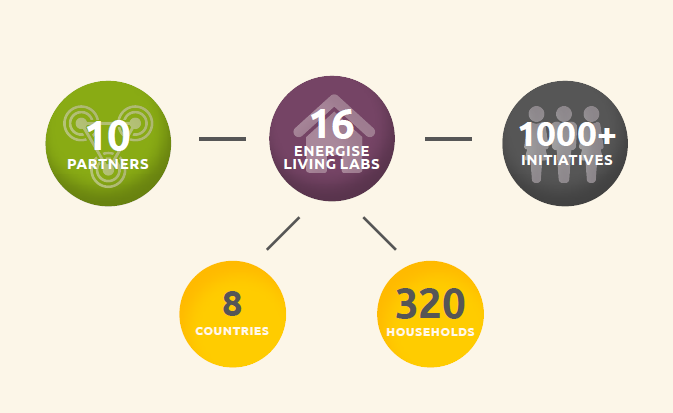
Figure 2: Project in numbers
Figure 2: Project in numbers
Data collection before, during and after the implementation of 16 Living Labs in 8 partner countries has proven instrumental to the design and assessment of energy consumption initiatives across Europe.
From the outset of the project, the ENERGISE consortium sought means by which to minimise the project’s environmental burdens (CO2 emission, waste, energy use, etc. due to project meetings, workshops, conferences, Living Labs). This included calculating project specific travel-related carbon footprints and the establishment of best practices for green(er) events. The details of these efforts were documented on the project website and shared with established networks. Thus, establishing environmentally conscious practices adoptable for future projects (across all areas of research).

This research was supported by the Ryan Institute, University of Galway.
Details of the Impact
ENERGISE offered novel social-scientific insights into factors driving individual and collective energy-related choices and behaviour. The project progressed academic, public and policy debates across Europe, directly addressing 7 major knowledge gaps that affect both national energy policy and the advancement of the European Energy Union.

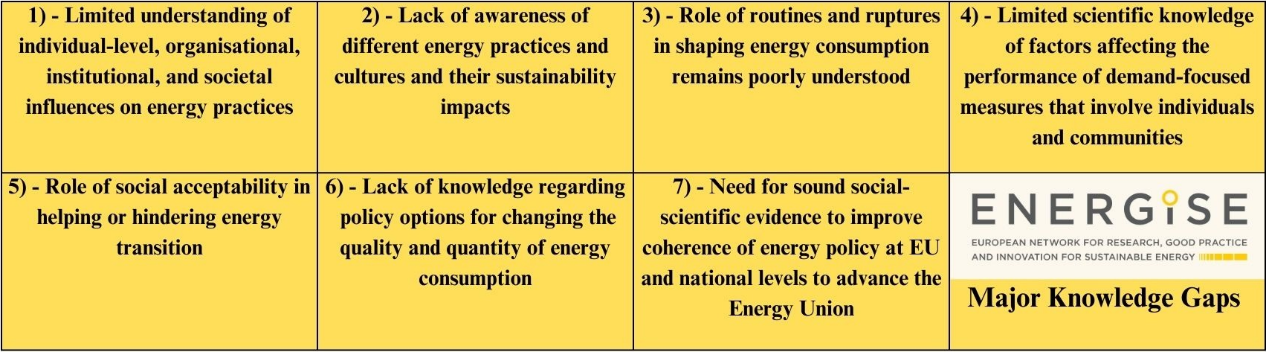
Figure 3: Major knowledge gaps addressed by ENERGISE
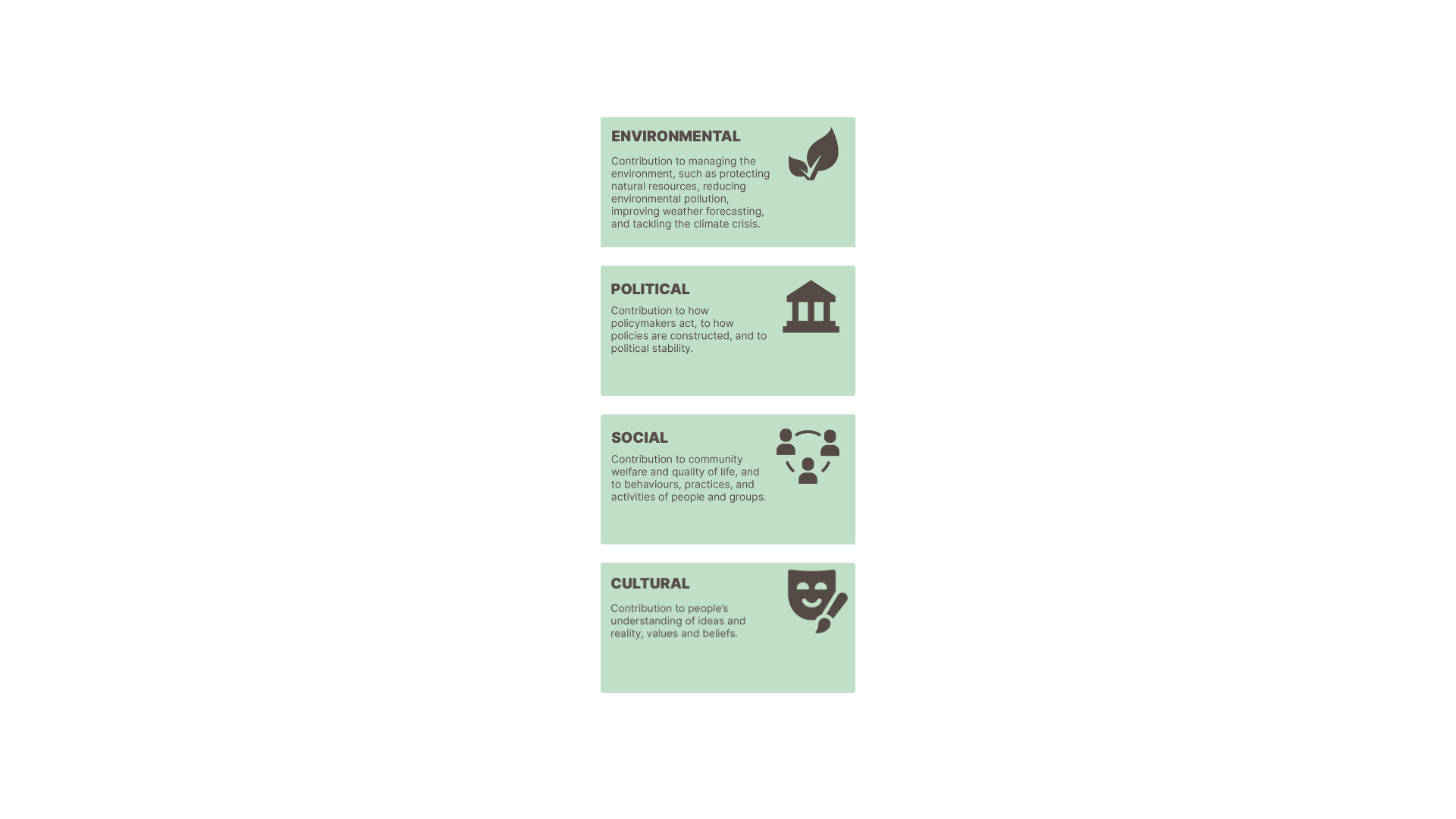
In addressing these gaps, ENERGISE brought about impacts in several areas.
Cultural
ENERGISE identified that cultural change is a key ingredient in successful energy transitions. Individual energy consumption is a function of who we are, where we come from, and the socio-cultural and material contexts in which we live. Societal norms and routines greatly determine our patterns of energy use as well as our ability and/or willingness to change those patterns. Without a comprehensive understanding of these energy cultures, public policy measures to reduce energy consumption at the individual or household levels are likely to fail. In designing and successfully implementing ENERGISE Living Labs, the project identified and challenged existing energy cultures. The project:
● Enhanced awareness and scientific evidence of the relationship between energy practices and cultures and their impacts on society and the environment.
● Developed ground-breaking scientific insights into links between energy routines and ruptures.
Attitudinal
In transforming energy cultures, ENERGISE achieved attitudinal changes in individuals and communities across Europe. The ENERGISE Living Labs directly impacted energy practices in 308 households across 8 European countries. The research compiled from these households, identified changes in individual and collective practices of energy consumption that have significantly reduced energy use. Camile Morend, a resident of Geneva who took part in the Living Labs, noted: ‘I really liked it because it allowed me to be aware of our impact on laundry heating, to think about it and act as a result’.
ENERGISE:
● Uncovered effective ways to turn everyday low-carbon practices into routines.
● Improved use of social-scientific evidence to address challenges to energy transition.
Policy
ENERGISE directly informed a Directorate-General Research and Innovation of the European Commission report on fostering knowledge valorisation through citizen engagement.

The language and recommendations from ENERGISE have found its way into new government strategy. This is evident in the Department of the Environment, Climate and Communications’ ‘Reduce your Use’ campaign which ‘supports households to actively manage their energy use, and in doing so, reduce their costs and carbon emissions’. Reduce your Use is supported by the Sustainable Energy Authority of Ireland (SEAI).
Reflecting on ENERGISE, Ruth Buggie of SEAI (Head of Mobility and Smart Networks) attests: ‘The research undertaken helped frame the policy and programme development opportunities for us as a national agency’. This is certainly the case with Reduce your Use, where emphasis is given to enabling proactive energy behaviours. Minister Eamon Ryan asserts that ‘The Reduce Your Use campaign offers useful energy saving tips’, noting that ‘the energy we conserve can make a big contribution to costs for individual households and can help us with energy security overall’.
ENERGISE thereby directly and indirectly informed national and EU-level policy options for changing quality and quantity of energy use.
The project:
● Identified and communicated policy implications and options at national and EU levels.
● Improved a collective understanding of current policy actions by individual consortium nations.
Environmental
The ENERGISE Living Labs implemented practices that enabled reductions in energy use in households across Europe. The project proved that if these practices were implemented across all households in Europe, the energy savings would be significant. For example, one less laundry cycle per week in Swiss households for a year represents a saving of around 13 million m3 of water, 10 million liters of laundry products and the equivalent annual electricity consumption of 90,000 households – if implemented by all Swiss households. A 1°C drop in room temperature, during the winter months when buildings are heated, results in an estimated saving of 6% of all energy dedicated to heating homes in Switzerland. The project has thus proven that incremental changes to household energy behaviours across Europe will unequivocally aid the transition to a decarbonised system.
ENERGISE:
● Progressed an understanding of theory to better understand and change energy behaviours.
● Assured that all project-related events were organised in the most environmentally and climate-friendly way possible.
Educational
ENERGISE has had a substantial and meaningful impacts on all consortium members and associated networks. The project has established and strengthened existing interdisciplinary networks and cooperation. ENERGISE has advanced academic understanding for sustainable energy across Europe and provided incentive for several offshoot pan-European research projects.



Research Funding

This research was supported by funding from the European Union’s Horizon 2020 Research and Innovation programme under Grant Agreement No. 727642.

References to the Research
R1. Fahy, Frances, Goggins, Gary, and Charlotte Jensen (eds). Energy Demand Challenges in Europe Implications for policy, planning and practice. Palgrave (open access). 2019. [accessed >96,000 times since publication].
R2. Genus, Audley, Fahy, Frances, Goggins, Gary, Iskandarova, Marfuga and Senja Laakso. ‘Imaginaries and Practices: Learning from ‘ENERGISE’ About the Integration of Social Sciences with the EU Energy Union’. In: Foulds, C. and Robison, R. (2018) Advancing Energy Policy. Lessons on the Integration of Social Sciences and Humanities. Palgrave (open access). 2018.
R3. Heiskanen, Eva, Laakso, Senja, Matschoss, Kaisa, Backhaus, Julia, Goggins, Gary, and Edina Vadovics. ‘Designing Real-World Laboratories for the Reduction of Residential Energy Use: Articulating Theories of Change’. GAIA Special Edition. 2018.
R4. Vadovics, E., Fahy, F., Goggins, G. (eds.) (2019) The ENERGISE Project Summary Handbook: Involving Households in Energy Change. ENERGISE – European Network for Research, Good Practice and Innovation for Sustainable Energy, Deliverable No. 7.13.
R5. Sahakian, M., G. Wallenborn and L. Godin (2019). Report on the analysis of ENERGISE Living Labs data across all eight participating countries. ENERGISE – European Network for Research, Good Practice and Innovation for Sustainable Energy, Grant Agreement No. 727642, Deliverable No. 5.2.
Evidence of Impact
E1. International Policy document: Monaco, Francesca et al. Fostering Knowledge Valorisation through Citizen Engagement. European Commission. 2024.
E2. Testimonial: Ruth Buggie (Head of Mobility and Smart Networks, Sustainable Energy Authority of Ireland).
E3. Testimonial: Camile Morend (Resident of Geneva). University of Geneva. ‘La consommation énergétique des ménages’ (Video).
E4. National Campaign: Department of the Environment, Climate and Communications, Reduce your Use.
E6. Offshoot Research Projects: EnergyPROSPECTS. Funded under the EU Horizon 2020 for three years, EnergyPROSPECTS aimed to assess the importance of energy citizenship. University of Galway led pan-European project.
E7. Offshoot Research Projects: EU 1.5° Lifestyles project. Funded by Horizon 2020, this pan-European project began in 2021 with the aim of establishing policies and tools for mainstreaming 1.5° lifestyles.
E8. Video Testimonial: Video from project partner Hungary featuring testimonials from industry experts and Living Labs participants. GreenDependent. ‘ENERGiSE Living Labs final event Hungary EN’. YouTube.
E9. Promotional Video for Living Labs: Germany / ENERGISE Energiespar-Studie. ‘ENERGISE - Machen Sie mit in Weilheim und Murnau!’ [ENERGISE - Get involved in Weilheim and Murnau!]’. YouTube.
E10. Promotional Video for Project: Hungary / GreenDependent. ‘ENERGISE Final video SUB ENG’. YouTube. 2020.