Nochtaithe (Unveiled ): an original performance created by university students in response to survivor testimony from the Mother and Baby Institution located in Tuam 1925-61


Summary of the Impact
Nochtaithe propelled new cultural and social spaces to inform, discuss and reflect on institutionalisation and national identity, childhood, gender, history and politics in twentieth-century Ireland. It enabled (1) recognition and healing for survivors, (2) intergenerational dialogue among survivors, students, staff and the public, and (3) educational intervention. The process, production and post-production encounters revealed the wider familial and intergenerational impact of this history on the broader community. Most significantly however, it solidified a unique and powerful relationship between the survivors and students that enriched each of their lives. Following an intense period of learning about local trauma and cruelty to the most vulnerable members of Irish society, students, survivors and staff involved in this production concluded the process feeling more community-bound, uplifted and strengthened.

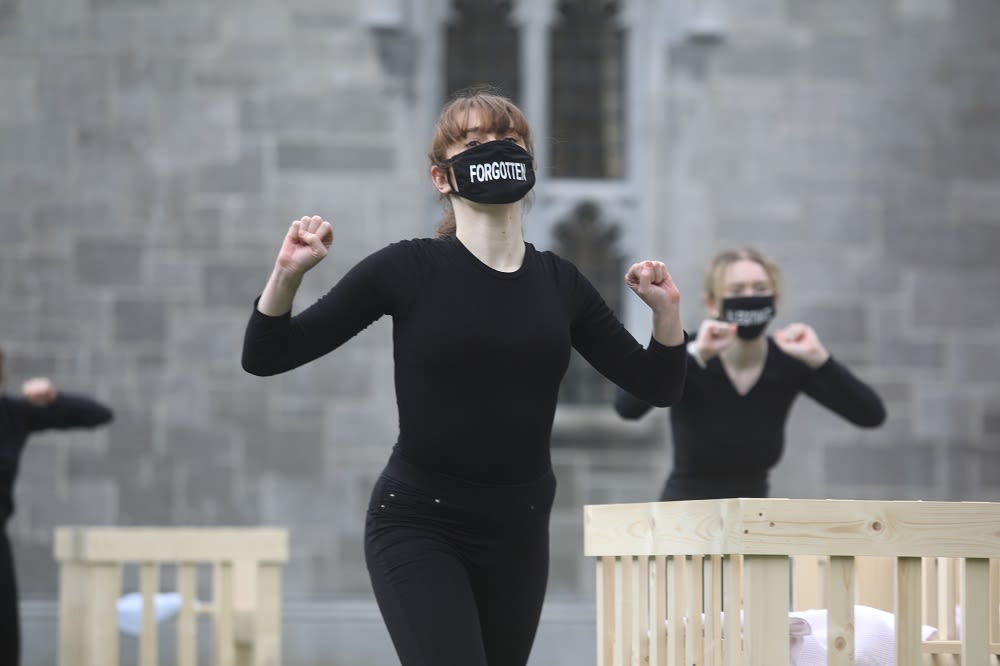
Nochtaithe reveals the expression of collective grief by students and survivors in rehearsal, performance, and post-performance as an expression of care for lives lost, for the intergenerational relations underpinning the Tuam Oral History Project (TOHP), and for each other as they confront a deeply contentious shared history that is violent, fractured, and intensely local.
Research Description
Nochtaithe demonstrates how Irish legal, religious, economic and cultural systems created an ‘architecture of containment’ (Smith 2007), captured through performance, performance art, dance, installation, spoken word, music and sound design. The research process was critically informed by Dr Miriam Haughton’s expertise in the theatres of trauma and politics, as captured in her lauded monograph Staging Trauma (Palgrave 2018) for which she received a TaPRA Early-Career Research Award Nomination in 2019, her co-edited collection Legacies of the Magdalen Laundries (Manchester UP 2021) and her performance analysis of ANU’s groundbreaking production Laundry published in leading international peer-reviewed journal Modern Drama (2014, 57:1), for which she was awarded the ‘Honorable Mention’ in their Outstanding Article Awards.
Drawing on Judith Butler’s theorisation of ‘grievable’ bodies (Frames of War) Nochtaithe reveals the expression of collective grief by students and survivors in rehearsal, performance, and post-performance as an expression of care for lives lost, for the intergenerational relations underpinning the Tuam Oral History Project (TOHP), and for each other as they confront a deeply contentious shared history that is violent, fractured, and intensely local. As an ethical choice we decided not to show some of the survivor transcripts to the students, particularly those that detailed sexual assault, as these students were not training in psychology nor social work. Instead, we focused the devising process on the testimonies that spoke to neglect, abandonment and lifelong educational and economic disadvantages suffered by those institutionalized in infancy and childhood. As the first half of rehearsals occurred during a Level 5 COVID-19 lockdown, we rehearsed over Zoom while the students remained living in their family homes. This yielded further unanticipated intergenerational impact, as parents and grandparents within their homes shared knowledge regarding personal connections to these Institutions previously not spoken of.
Nochtaithe (Unveiled) Performance
Watch the performance Nochtaithe (Unveiled), devised by students from Drama and Theatre Studies at University of Galway.
Nochtaithe features:
- Extracts from Tuam survivors telling their experiences as part of a podcast series led by Dr Sarah-Anne Buckley (University of Galway), Lorna Farren (University of Galway), and Orla Higgins (Independent Producer)
- Historical context outlined by TOHP PIs Dr Buckley and Cunningham (University of Galway)
- Archival context from Dr Barry Houlihan (University of Galway)
- Scenes devised by students to respond to testimonies through multidisciplinary performance co-created with Dr Haughton supported by performance workshops online with ANU Productions
- Voice-over performance from poet, novelist and creative writing lecturer Elaine Feeney (University of Galway)
- Extracts from official comments made by Irish politicians– Catherine Connolly TD, former Prime Ministers Micheál Martin, Enda Kenny, and Bertie Ahern - in relation to government inquiries and reports into institutionalization (1999-2021)
- Professional cinematography and editing (Seanchas Productions)
- Music by acclaimed Irish musician Colm Mac Con Iomaire
- Post-performance panels with journalist Conall O’Fathartha, Tuam survivors, students, and university lecturers for the Bealtine Festival (May 2021), the Liverpool Irish Festival (October 2021), and St Patrick’s Day events at São Paulo University, co-sponsored by the Irish Embassy in Brazil.
- Reviews/features/interviews in print: Irish Times, Connacht Tribune, Tuam Herald; on radio: Galway Bay FM; online at RTÉ.
Nochtaithe (Unveiled) – Behind the Scenes Trailer - produced for the Bealtaine Festival as part of the University of Galway Tuam Oral History Project.
This short trailer offers a glimpse into the creative and emotional process behind Nochtaithe, a multidisciplinary performance created by university students in collaboration with Dr Miriam Haughton.
"Its been such a pleasure to work with the survivors and tell their stories, and, to explore this area of Irish history that has been so deeply hidden from the world and from Ireland for so many years. We can never undo the past but what we can do is bring some kind of recognition to the bravery of the survivors."
"I’m glad to be here, to be alive to tell this story, I hope that people that comes after me can see that."

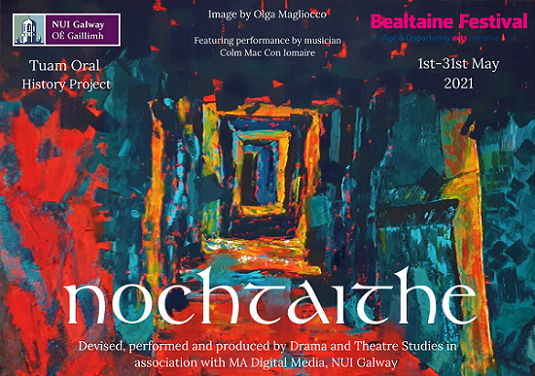
"So often we view history as something that has already happened, we kind of relegate it to the past and ignore the fact that history is alive, it is constantly evolving and that we are part of this, we have agency. That’s why I think this project is so important because it allows us not to forget."
Details of the Impact
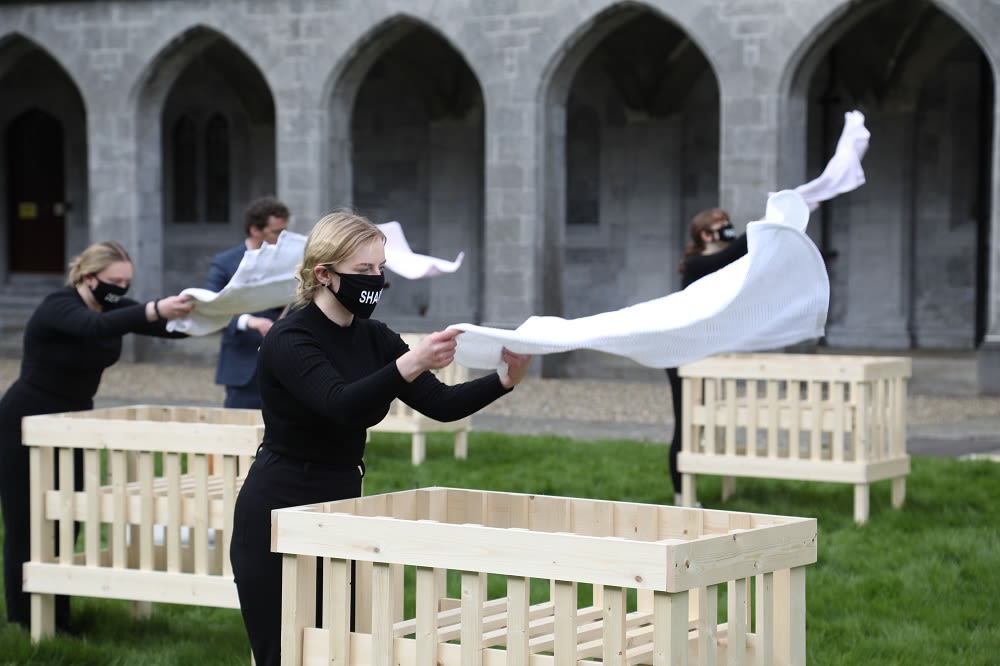
Production/Student Details: This multidisciplinary approach (performance and live art, poetry and spoken word, dance and installation, media) resulted in a 45-minute filmed performance led by Dr Haughton in collaboration with eleven undergraduate and three postgraduate students in spring 2021, programmed in Bealtaine Festival (May 2021) and Liverpool Irish Festival (October 2021). It is also accompanied by a 5-minute ‘Behind the Scenes’ trailer, and both recordings remain freely accessible online. The stylised performance relied on physicality but not dialogue. Voice over and sound design added during the editing process. The repetition of pushing, stretching and collapsing signifies the sense of ongoing pain suffered by survivors and families whose search for personal and burial records of relatives remains blocked by varying legal and bureaucratic procedures. The physicality of the performance also offered a way to respond through the fullness of our corporeal selves. The women’s bodies, and those of their children, became invisible to wider society due to this architecture of containment, enabling the prevention of intervention in varying degrees. It was important to foreground and render visible an embodied response to this distinct absence of bodies from the public sphere. Furthermore, the difficulty of finding the right words or language to convey the magnitude of this history often resulted in a form of creative paralysis, or risked cliché.
Project/Community Background: Death records for 796 children over a forty-year period are not accompanied by burial records (Corless 2012; Final Report of the Commission of Investigation into Mother and Baby Homes 2021). Fetal, baby, and infant remains have been found in a sewage tank at the site of the institution (Commission 2021), demolished since the 1970s. The vast majority of mothers sent to the Institution are no longer alive, and thus, survivor voices of their children (now elderly) are the most significant and accessible record for addressing this difficult past.
Critical Context Framing Research Project: In Frames of War (2009), Butler’s contention that some lives are rendered grievable by prevailing power structures while others are not measured with equal value offers an insightful lens for how certain prevailing hegemonic ideologies in 20th century Ireland concealed a deeply punitive culture for women and children, and more widely, economically-disadvantaged communities. Butler builds on her earlier work in Precarious Life (2004) by arguing that ‘specific lives cannot be apprehended as injured or lost if they are not first apprehended as living’ (2009: 1). She expands, ‘Subjects are constituted through norms, which, in their reiteration, produce and shift the terms through which subjects are recognized’ (3-4). Unmarried mothers and their ‘illegitimate’ children in Ireland were constructed as Others, while heterosexual marriage became the norm through which subjects were constituted in order to access full and fair treatment by the law and wider social acceptance. Furthermore, class dynamics played a major role in the constitution of ‘norms’ and the process of Othering during this historical period.
Direct Beneficiaries: The most significant beneficiaries of Nochtaithe were the Tuam survivor members of the advocacy group ‘The Tuam Home Alliance’ (THA) and the university students. Survivor testimonies were shared with Dr Haughton who used them as a blueprint for devising an original multidisciplinary performance. The proposal for Nochtaithe was put to the THA and received approval. Survivors met with the students and Dr Haughton multiple times during rehearsal online due to COVID lockdowns. The first cut of the filmed performance was sent to the THA for private viewing who were invited to submit feedback directly to Dr Haughton, the TOHP team, or via an advocate, which they did. Following unanimous approval by the THA to release Nochtaithe on public platforms, post-performance discussions were also programmed which included representatives from the THA, TOHP and students. Through this process, the THA felt their personal experiences were understood, believed and respected by the students and wider public. The students’ understanding of Irish history, society, politics and culture underwent major critical reflection and analysis, with many learning for the first time about Ireland’s history of institutionalisation, and the lifelong disadvantages and trauma survivors’ experienced as a result.
Community Engagement: The Bealtaine Festival (May 2021) was established in 1995 and is the world’s first national celebration of creativity in older age, reaching annual audiences of 10-12000 people approximately. The performance, followed by a panel discussion, spoke directly to Ireland’s older generations who possess more knowledge and memories of institutional experiences. Programming in Liverpool Irish Festival (October 2021) provided an opportunity to engage with the significant Irish community in the UK, some of whom emigrated there following experiences in Ireland’s institutions. LiF has an annual audience reach of approximately 10,000 people. As part of the LiF’s ‘In:visible Women’ series, we produced a day-long event with Nochtaithe bookended by webinars with survivors, legal experts, historians, artists working across the island of Ireland and Britain, and Ireland XO, Ireland’s national archive for ancestry. The students also benefitted from this as they learned the processes involved in drafting press releases, preparing publicity packages, and reflectively analysing their own creative work.

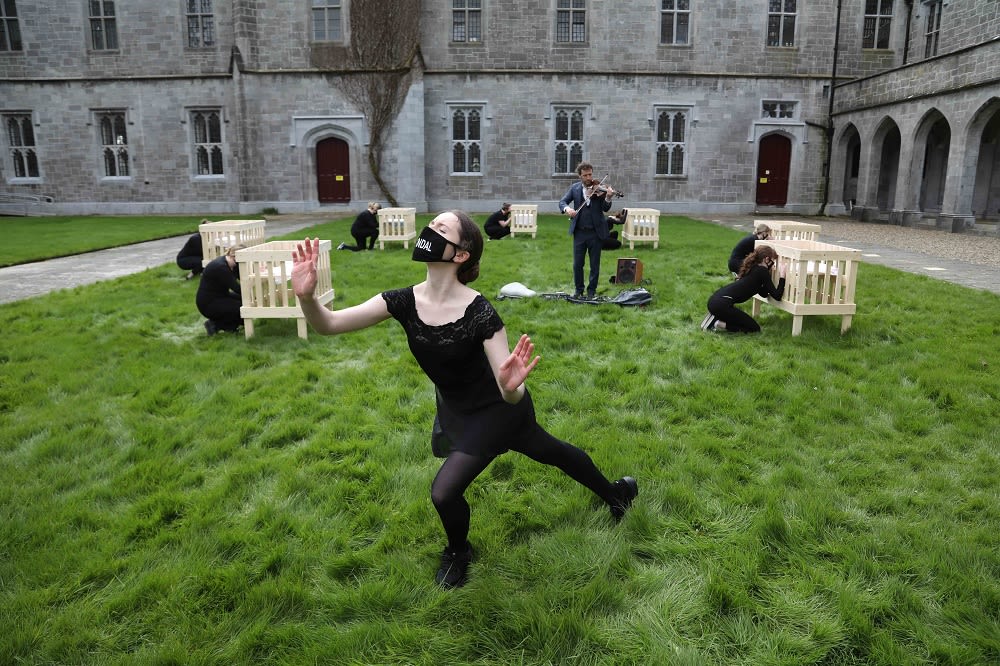
Rehearsal during lockdown and the creative potential it brings
Colm Mac Con Iomaire plays the violin while students Leanne Anderson and Sarah Dooley perform to Emer's Dream inside the Quadrangle Building at NUI Galway. Photo: Aengus McMahon.
"As an American student, I did not initially know much about the project or the history of the Tuam Home…As this project is informed by Irish history and politics, I wanted to situate the students’ practice within the lineage of Irish performance art. Áine Phillips writes that Irish performance art has always been deeply political and was used "to speak what was before unspeakable", which is exactly the purpose of the Tuam Oral History Project."
Scandal, silence, shame: the careful retelling of a buried story
"Quoting survivor Christine Carroll in the post-performance webinar ‘the generation that’s coming up, the students – they’re the ones helping us, in a way. You might say they’re counselling us more than anything else."

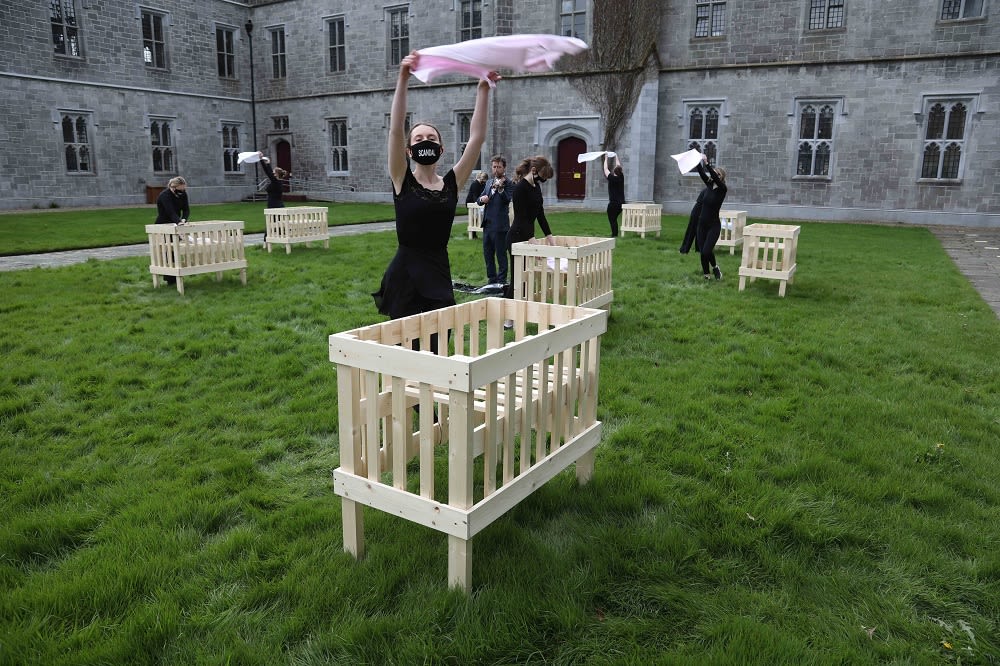
Nochtaithe was produced as a creative output of the multidisciplinary research project ‘The Tuam Oral History Project’ (TOHP). The TOHP is a survivor-led project established in 2019 to archive testimonies from families and communities associated with the Tuam Mother and Baby Institution led by historians Dr Sarah-Anne Buckley and Dr John Cunningham, sponsored by the Galway University Foundation.
Research Funding

This research was supported by funding from Galway University Foundation

References to the Research
- R1. ‘Behind the Scenes’ Trailer: https://www.youtube.com/watch?v=8Z4LvmOXfnQ&t=13s.
- R2. Sarah-Anne Buckley, John Cunningham, Miriam Haughton and Barry Houlihan, ‘To Talk, To Tell, To Share: The Tuam Oral History Project,’ Cátedra de Estudos Irlandeses (2021) ed. Laura P. Z. Izarra, São Paulo University, translated into Brazilian Portuguese, pp. 91-124.
- R3. Catherine Corless, ‘The Home’, Journal of the Old Tuam Society Vol. 9 (2012), pp. 75-82: https://www.bishop-accountability.org/reports/2012-12-Corless-The-Home.pdf.
- R4. Miriam Haughton, ‘Performance, Care, and Intergenerational Response: Grieving for ‘Ungrievable’ Bodies in the Tuam Oral History Project,’ Performance Research (2022) 27: 5-6, 111-119, special issue ‘On Care’: https://www.tandfonline.com/doi/full/10.1080/13528165.2022.2198307.
- R5. Nochtaithe: https://www.universityofgalway.ie/tuam-oral-history/nochtaithe/.
- R6. Tuam Oral History Project: https://www.universityofgalway.ie/tuam-oral-history/.
- R7. Deirdre Falvey, ‘Scandal, silence, shame: the careful retelling of a buried story’, Irish Times, 8 May 2021, p. 6: https://www.irishtimes.com/culture/stage/scandal-silence-shame-the-careful-retelling-of-a-buried-story-1.4557092.
Evidence of Impact
E1. Michael O’Flaherty, Tuam Survivor, Archival Testimony recording, used in ‘Behind the Scenes’ trailer 2021 (min 3.55- 4.02):
- ‘I’m glad to be here, to be alive to tell this story, I hope that people that comes after me can see that.’
E2. Laura Brincat (MA student 2020-2021), ‘Rehearsal during lockdown and the creative potential it brings’, RTÉ Brainstorm, 30 April 2021: https://www.rte.ie/brainstorm/2021/0426/1212196-creative-potential-rehearsal-lockdown/.
- Brincat states ‘As an American student, I did not initially know much about the project or the history of the Tuam Home…As this project is informed by Irish history and politics, I wanted to situate the students’ practice within the lineage of Irish performance art. Áine Phillips writes that Irish performance art has always been deeply political and was used "to speak what was before unspeakable", which is exactly the purpose of the Tuam Oral History Project.’
E3. Deirdre Falvey, ‘Scandal, Silence, Shame: the careful retelling of a buried history’, Irish Times, 8 May 2021: https://www.irishtimes.com/culture/stage/scandal-silence-shame-the-careful-retelling-of-a-buried-story-1.4557092.
- Quoting survivor Christine Carroll in the post-performance webinar ‘the generation that’s coming up, the students – they’re the ones helping us, in a way. You might say they’re counselling us more than anything else.’
E4. Ikenna Anyaibuike, BA Drama and Theatre Studies student, ‘Behind the Scenes’ trailer 2021: https://www.youtube.com/watch?v=8Z4LvmOXfnQ&t=13s (min 3.35-3.53).
- ‘So often we view history as something that has already happened, we kind of relegate it to the past and ignore the fact that history is alive, it is constantly evolving and that we are part of this, we have agency. That’s why I think this project is so important because it allows us not to forget.’
E.5 Laura Hutchinson, BA Drama and Theatre Studies student, ‘Behind the Scenes’ trailer 2021: https://www.youtube.com/watch?v=8Z4LvmOXfnQ&t=13s (min 3.05-3.28)
- ‘Its been such a pleasure to work with the survivors and tell their stories, and, to explore this area of Irish history that has been so deeply hidden from the world and from Ireland for so many years. We can never undo the past but what we can do is bring some kind of recognition to the bravery of the survivors.’
E6. Ger Henry Hassett is a Galway resident who viewed Nochtaithe and the post-performance interview online with university students and institutional survivors during the Bealtaine Festival. Ms Henry Hassett then made contact with Dr Haughton, though neither had met or been in contact previous to the release of Nochtaithe. Email sent 26 May 2021, at 13.20:
- ‘Dear Miriam, I have been thinking about Nochtaithe since I viewed it at the online event on May 1st. It was compelling from the opening sequence. I found it very emotional yet I felt I was seeing it through different eyes despite being familiar with the Tuam Baby story. It was particularly heartening to hear both Annie and Natasha speak. Young voices bringing an understanding to the story as older generations are drowned in shame. I have been a supporter of the survivors since I attended the vigil in Tuam on All Souls Night 2016. I was deeply affected by the sheer anguish, despair and emotion expressed at that site as we stood in the dark with the commingled remains of 796 babies beneath our feet… I would like to wish you every success with Nochtaithe. Kind regards, Ger Henry Hassett, Headford.’
E7. Professor Anne Byrne, School of Political Science and Sociology at the University of Galway, emailed the TOHP team following viewing Nochtaithe. Email sent 14 May 2021, 15.29:
- Dear Sarah-Anne, Barry, John, Miriam and colleagues. Thank you for this work. Eavan Boland expresses how I feel. ‘But these are women we loved./ Record-keepers with a different task./ To stop memory becoming history./ To stop words healing what should not be healed.’ (The Historian).’ Coincidentally, I have been reading the Commission of Inquiry report this week, struggling with the framing, the absence of multidisciplinary perspectives, the turning of accounts of lived experience into history only - I know you understand. The non- return of transcripts is more than an ethical breach. What happened?. Survivors of the institutions face the world alone but work like Nochtaithe does make a difference. Beir Bua, Anne.’