
A Systems Dynamics Simulator For Generating COVID-19 Scenarios
Informed Ireland’s Public Health Decisions



Summary of the Impact
In March 2020, the onset of the COVID-19 pandemic created an immediate and pressing need for the Irish Government to establish new modelling capacity to inform public health decision-making. In response, the Irish Epidemiological Modelling Advisory Group (IEMAG) was swiftly formed, drawing together essential expertise from both academic and health sectors. Leveraging this extensive background, Prof. Duggan was invited to contribute to two expert advisory bodies during the COVID-19 pandemic: initially with the Health Service Executive’s (HSE) Modelling Impact Group, followed by the newly-formed Irish Epidemiological Modelling Advisory Group (IEMAG), an expert subgroup of the National Public Health Emergency Team (NPHET). Prof. Duggan worked closely and collaboratively with IEMAG colleagues for the Office of the Chief Medical Officer. His methodological approach was grounded in the system dynamics modelling framework, an iterative problem-solving process that included: (1) problem articulation and boundary selection; (2) generation of a dynamic hypothesis; (3) model formulation (ordinary differential equations); (4) model testing, including data fitting; and (5) policy evaluation using scenarios.


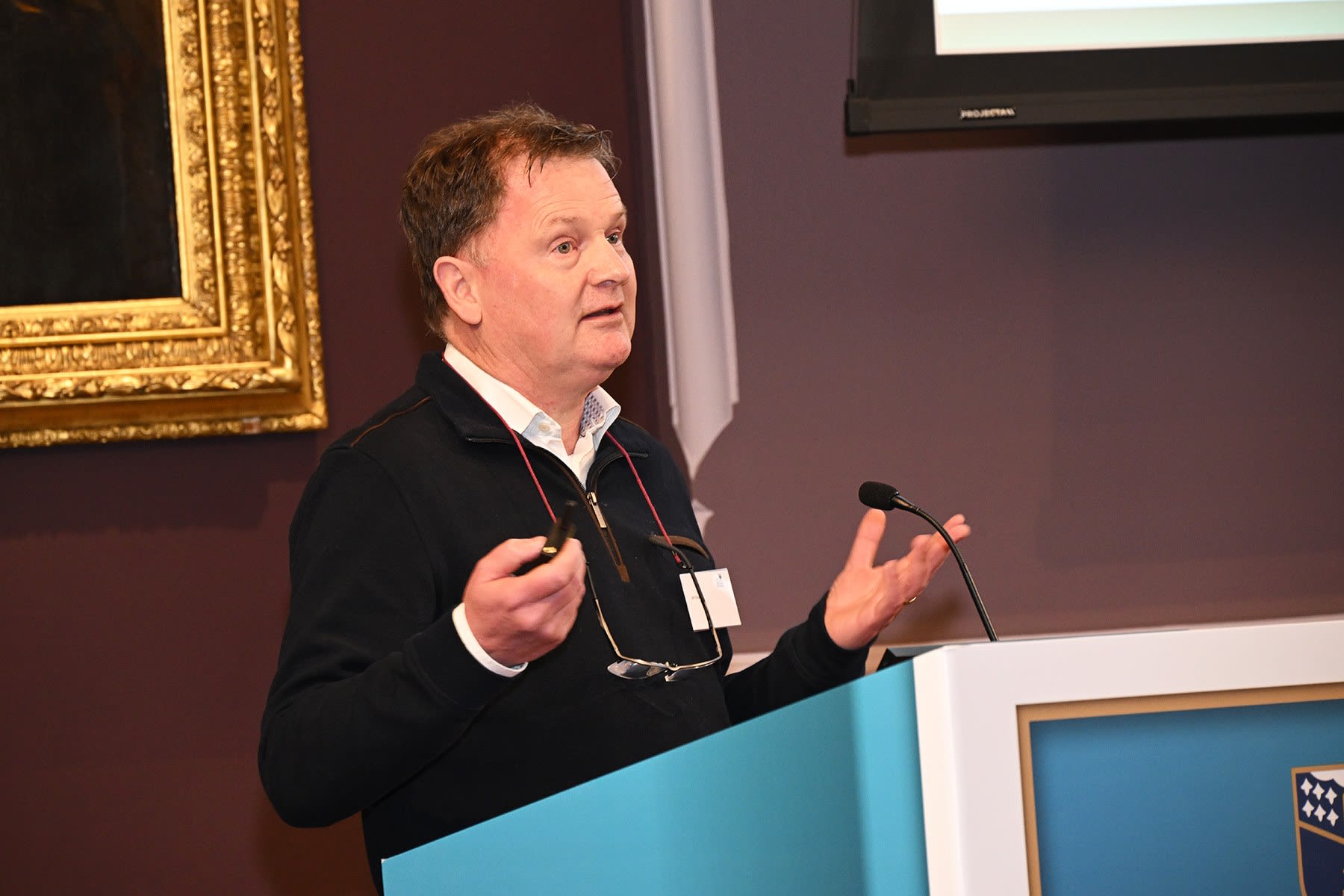
Prof Jim Duggan received the Jay W.Forrester Award at the International System Dynamics Conference in Boston University on 5 August, 2025 for this case study
Prof Jim Duggan received the Jay W.Forrester Award at the International System Dynamics Conference in Boston University on 5 August, 2025 for this case study
Internationally recognised for his system dynamics and mathematical modelling expertise, Prof. Jim Duggan significantly impacted Ireland's COVID-19 response. He developed an age-cohort infectious disease simulator that informed public health restrictions and hospital resource planning during the 2020-2022 pandemic peak. This vital work continues to influence the Health Service Executive's public health governance, demonstrating the enduring impact of his research. Prof. Duggan’s interdisciplinary work focuses on developing modelling methods to support public health and the management of infectious disease outbreaks. His prior related contributions included the establishment of influenzanet in Ireland; participation on the University of Galway, School of Medicine-led EU projects PANDEM and PANDEM-2; and, theoretical modelling contribution in the area of calibration and model inference.
Research Description
As part of Prof. Duggan’s contribution, he focused on the design and implementation of an age cohort model for generating case projections across different age cohorts. The model was required by the NPHET in order to complement the IEMAG population level model and agent-based model, and also to help address issues such as the impact of vaccination of different age groups. The age cohort model was initially derived from published work in Nature Medicine and an early (three-cohort) version was made available to IEMAG in the summer of 2020 for exploratory analysis. Following enhancements, including the addition of vaccination, variant modelling, and a new form of breakpoint analysis, the (six-cohort) model was established as one of the operational models used to inform NPHET from January 2021 to February 2022. The modular simulator design (1) enabled a simplification of the disease transmission structure; (2) provided a practical workflow to coordinate activities; and (3) speeded up the process of scenario generation and the requirement to provide timely and informative scenario analysis to support Ireland's pandemic response.
While the simulator design was challenging in itself, an additional task was to operationalise the model, and therefore support public health decision making in a timely an reliable manner (often on a weekly basis). This was achieved through the design of a novel workflow, where weekly data from the Health Protection Surveillance Centre triggered a sequence of steps, including:
1. The generation of breakpoint estimates and growth rates by a colleague in IEMAG, which provided important changepoints for the calibration process.
2. The input of vaccination schedules based on the latest Department of Health estimates, factoring in the vaccine type and parameters relating to efficacy and waning immunity.
3. Based on the latest data, contact matrix multipliers would be re-estimated.
4. Using scenario scripts specified by NPHET, many simulations would be run to show potential trajectories of cases. This would also include sensitivity analysis to see a plausible range of outputs based on stochastic noise in the model.
5. The results were generated for export, model assumptions shared, and data exported to Excel files to the hospital planning system (CHUP) and to NPHET for presentation and discussion.
Details of the Impact
Impact I
Decision Support during the COVID-19 Pandemic
An important output from the Age-Cohort model was that case projections were used by IEMAG colleagues generating demand/supply modelling scenarios, and in particular, the COVID-19 Hospital Utilisation Planning Model (CHUP) model to investigate how best to utilise resources to meet expected demand. These CHUP projections were made available to the Health Service, and were a valuable input into the planning process during the COVID-19 emergency. Evidence of this impact can be confirmed through the letter (16/12/2021) from the Chief Medical Officer (Dr. Tony Holohan) to the Minister for Health (Mr. Stephen Donnelly TD), which included a section on Modelling containing advice – informed by modelling outputs -
“the risk of excess demand for healthcare is difficult to estimate, but is considered very high”. In Appendix 3 of that letter, the CMO confirms the role of the disease models as inputs to the CHUP model by stating that the “scenarios have been implemented in the homogeneous population SEIR model and the age-cohorted SEIR model, and the outputs of these models translated into healthcare demand using the ESRI CHUP model, as previously described and published.”

Impact II
Ongoing Development of Public Health Governance
Prof. Duggan's pivotal COVID-19 role has informed Ireland's public health governance. His established collaboration with the Department of Health and HPSC (via IEMAG and NPHET) led to a 0.2 FTE secondment with the HPSC in August 2023.
- This engagement allowed him to apply Age-Cohort model insights and related research, directly enhancing national public health capabilities by developing an operational model for weekly hospitalisation forecasts—critically improving HPSC's capacity for proactive planning and resource allocation.
- The work involved providing a training workshop on a modelling method known as POMP (partially observed Markov processes), applied to seasonal influenza models, and advanced the HPSC's internal modelling and analytical capacity for data-driven disease surveillance.
- The applied modelling work was presented at the European Scientific Conference on Applied Infectious Disease Epidemiology (ESCAIDE) in Stockholm, and the Royal College of Physicians of Ireland Winter Scientific Meeting in December 2024.


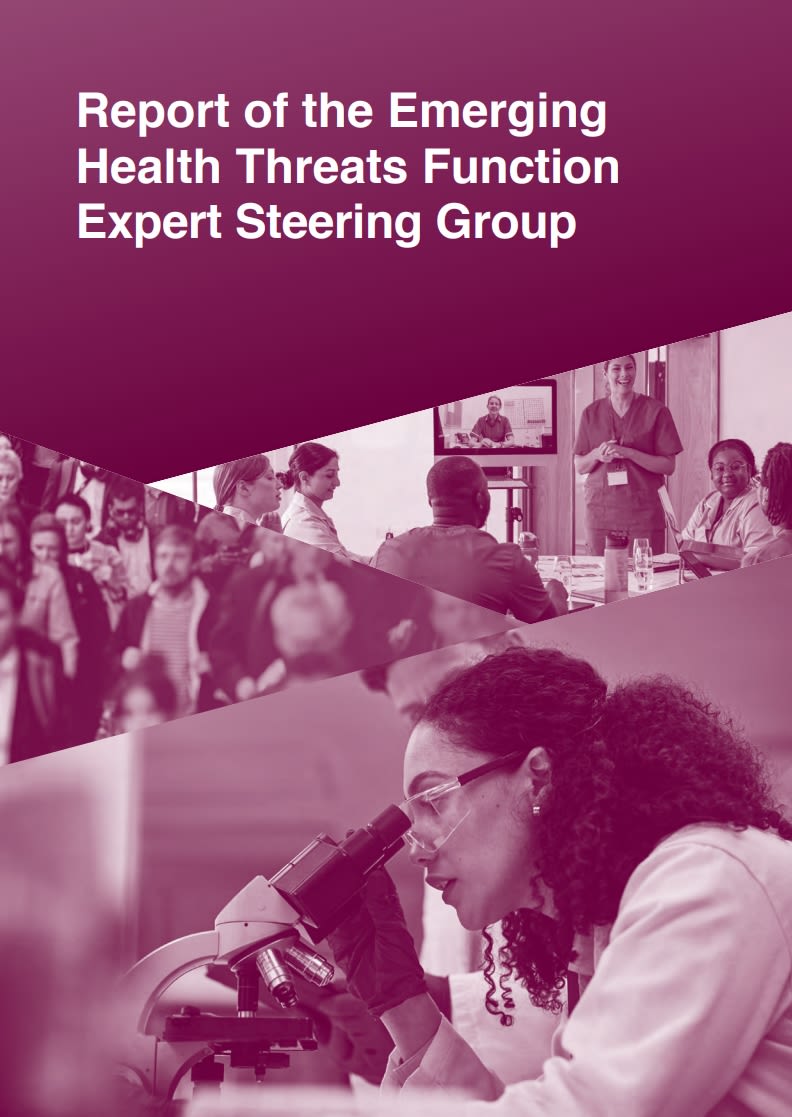
Beyond individual contributions, the IEMAG Team made a foundational impact on Ireland's long-term public health governance. Their comprehensive 2021 study on international modelling capacity, detailed in the 2024 Emerging Health Threats Function Expert Steering Group report, directly led to a critical recommendation:
"To develop a national biostatistical and modelling capability for both infectious and non-infectious threats to enable valuable health intelligence that will inform timely public health actions and policies."
"Modelling and data analysis skills are critical components of an effective public health system, providing valuable health intelligence that helps inform decision making and policy setting"
"Limited public health modelling capacity is available within the public health system and the Irish Epidemiological Modelling Advisory Group (IEMAG) was established to provide this expertise on a volunteer basis during the COVID-19 pandemic."


Research Funding


This publication has emanated from research supported in part by a grant from Taighde Éireann - Research Ireland under Grant numbers SFI/12/RC/2289_P2 and SFI/16/IA/4470.
References to the Research
- The paper was published by the EJOR in 2024 (Duggan et al., 2024) with the following DOI: https://doi.org/10.1016/j.ejor.2023.08.011
- The paper has been cited 12 times to date (June 2025), including a recent review of 50 years of operational research applied to healthcare (Beliën, Brailsford et al. 2024), published in the European Journal of Operational Research.
- Reviewer feedback from our European Journal of Operational Research publication, including the following comments:
a. "I think this is very important work that highlights an innovative application of OR/quantitative tools in the support of policy discussions around a globel pandemic. This submission provides a clear and compelling narrative."
b. "Even though in my personal opinion the world already contains more than enough COVID midels, I found the paper an interesting and enjoyable read. It presents a historical overview of the model development process during 2020 and 2021, and describes the close collaboration with experts from other disciplines and the interactions with policy makers. It also describes how the model was modified as new variants emerged, dividing time into distinct epochs based on reported epidemiological data, which (to the best of my knowledge) differentiates this model from many others in the literature."
Evidence of Impact
1. On the front page of the Sunday Independent, 19th December 2021 Vol. 116. No. 51. “NPHET Warns of up to 400 Covid Cases in ICUs by January”, by Maeve Sheehan and Hugh O’Donnell. Text includes:
a. “Prof Philip Nolan, the chair of NPHET’s modelling committee, has said that, in a worst case scenario, 1,500 could be in hospital and another 400 requiring critical care when the surge peaks.”
b. “Modelling based on 72 different sets of assumptions shows that cases will rise to 8,000 to 10,000 if social contact is reduced by 10pc, according to the thread. If thevirus proves more evasive, the modelling predicts cases of 20,000 per day.”
c. “The worst-case scenario forecasts were circulated to hospital groups on Wednesday as the braced for an unprecedented surge in Covid-19 that is expected to take off by the end of this week.”
2. The following relevant quotation is from the Memoir of Dr Tony Holohan, Chief Medical Office and Chair of the National Public Health Emergency Team during COVID-19. It confirms how IEMAG was an entirely new national modelling capacity, and that the outputs from IEMAG informed all the advice and decisions that would be made over the coming years.
“The task was to build a new pioneering national capacity and process for the purpose of Covid. It needed terms of reference, members to join, a process to operate, and a chair. Philip Nolan agreed to chair it. Philip made himself available in a fully committed way over the course of the pandemic to build a team of the best analytical brains in Ireland to model the disease and its patterns to inform all the advice and decisions that would be made over the coming years. The members of the team gave of their time selflessly and in a spirit of true public service. They were unfairly criticised for ‘getting it wrong’, including by many who would and should have known better, but it did not deflect them from their work. They published their minutes in full and made their models available for public scrutiny.”
3. Outputs from Government reports corroborate and confirm the use of the model to inform decision making, specifically regular correspondence from the Chief Medical Officer to the Minister for Health, where public health advice and recommendations included modelling summaries and also appendices with additional modelling details.